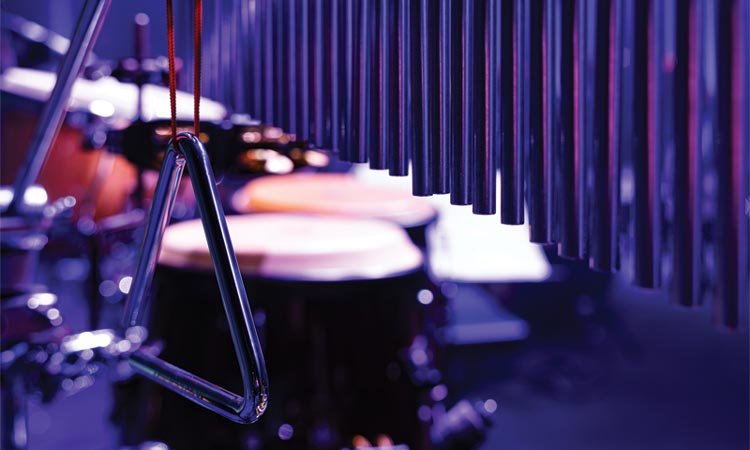
I can’t help but smile when I hear someone say, “Oh, the only musical instrument I play is the triangle!” Usually it’s meant to jokingly inform others of how unmusical the person is, but actually, the triangle can be quite difficult to play properly. Of course, it’s not a real show-stopping skill and it’s definitely less involved than a lot of the other instruments, but it has different tones and is usually critically timed and tied to important rhythms.
I found this out the fun way when one of our ensemble pieces required a triangle to be played at a few very opportune moments throughout. Since all the musicians were already occupied playing their instruments, we recruited someone’s brother to fill the role of tapping the little triangle at the right moments. Not considering the triangle to be a “real” instrument, we could not see this going wrong at all—in fact, we never even gave it a second thought.
We practiced without the triangle most of the time, because the brother was busy and we didn’t put much stock in his part anyway. Then, a few days before the concert, we called him in for a practice session or two. This was when we realized that we had made a big mistake.
While willing and good-natured, this guy was not the best listener, and no matter how much we explained, drew diagrams, or demonstrated what he was to do, he never seemed to really remember or follow our instructions. He seemed to be applying the scripture that says, “Whatever your hand finds to do, do it with all your might” (Ecclesiastes 9:10 NIV). But since that verse unfortunately does not include “do it with all your accuracy,” he treated timing as a mere suggestion and enthusiastically clanged away on that little metal triangle whenever he felt like it.
After many starts and stops, we took a break. To be honest, we were all quite shocked at this turn of events. And as much as we wanted to believe that we were the stars of the show, we began to realize that this tiny, basic, little percussion instrument could somehow easily (and negatively) overshadow all our parts. Now, instead of being a fun little addition, the triangle was a major focal point, and it became vital that we got those few little dings right.
We resumed rehearsing with this realization front and center in our minds. But the actual player of the triangle still hadn’t understood his role. And regardless of how the conductor, other musicians, or his sister impressed upon him the importance of his role, he remained cheerful but oblivious. Between his refusal to accept the importance of his part and our continued efforts to get it in tempo, the rest of the practice is a blur in my memory.
What I do recall perfectly are those first few attempts and the clear lesson we learned: The triangle, though small, simple, and unimpressive, was important. All the hassle was caused because we had assumed it wasn’t. We thought that, because it didn’t have the most glorious or biggest part, it was of less value.
Thinking that the grandness or the required skill of a task equals the importance of a task is a mistake. It’s always been the little jobs, people, and things that truly make the world go round. The triangle is not a hard instrument to play. It’s not a very impressive one either. It usually doesn’t have incredibly involved and intricate parts. But it is important.
So indeed, little things matter, whether that little thing is a triangle or a triangle player, a cheerful janitor or a friendly cashier, a loving preschool teacher or a skilled construction worker, or any manner of inglorious, unseen roles that don’t make headlines or trend on social media but that are appreciated forever by a loving God who sees it all. Those people, jobs, parts, and roles are important to Him! And they should be important to us as well.